
What started as a settlement by the reeds is now the capital of a superpower that can determine lots of things — and it’s not just war or peace, but how much you pay for your plush toys (made in China, of course) in your American supermarket. And the city, indeed, is forbidding at first sight. Travellers arriving at Beijing West are informed, by loudspeakers on repeat, that they are in “the capital”. Highway travellers queue — without exception — at Capital Checkpoints, where I once had a thin strip of green cardboard confiscated (how political can cardboard be?) and had to leave the car with my hands held high (fortunately with nothing recorded against me). The centre of the capital has both a square that is accessible only after a strict ID and security check, and is home to a place where unauthorised aliens were executed upon discovery — the equally verboten-sounding-in-name Forbidden City. (In an attempt to make it sound less forbidding, City Hall much prefers the neutralised term Palace Museum, but that’s just them, I guess…)
Propaganda slogans and red national flags dot the city (but hey, you see the national flag in other lands too — at many a roundabout in Morocco, for example). Move away from the part of town with goosestepping soldiers guarding the flag, though, and you see a very different part of town — one that only occasionally ends up on TV abroad. Of narrow alleyways being redone (some since gone), but also of remote mountain villages few people know of. Next to the venues that hosted both the Summer and Winter Olympics are both ultra-modern convention centres and, more interestingly, places where it looks like you’ve just ventured into Tibet, or the supertowers that had to be redone in shape — even after completion. Catch the last bits of the “old, yet not too old” Beijing (1949-1978), or take a guess where the newest motorways might be heading for.
There’s a story, too, about how the city grew to be the megalopolis it is today. Did you know that Beijing Chaoyang railway station used to be known by a different, Mao-era name? Gaoyibo Hutong had its name “gentrified” from that part of a common pet which is wagging when the animal is happy; meantime, there’s a part of northeastern semi-suburban Beijing that still clings on to its pretty explicit name, featured on bus signs as route termini. Long-time residents, too, will notice how big the city has changed — and it’s everything, from road sign fonts to outright grand rebuilds.
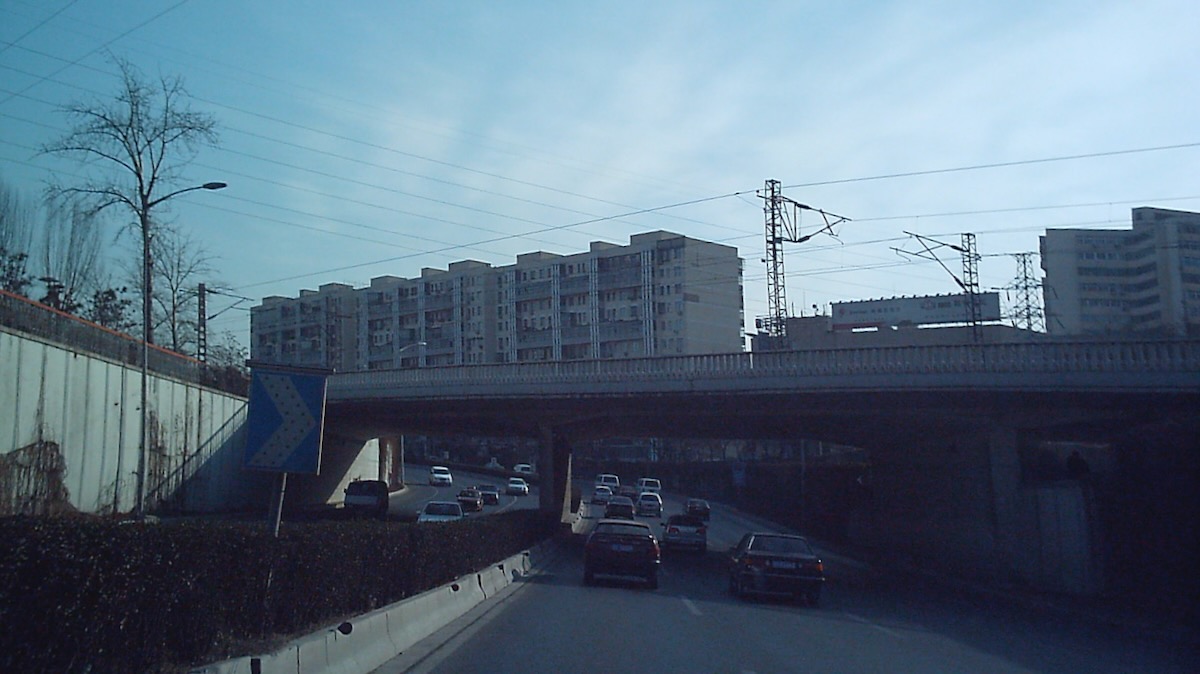
The city, too, is where connections are made — where East meets West. The railway bridge you see here is that by the southeastern 2nd Ringway (Ring Road) shortly before China’s first 350 km/h HSR route was built (the High Speed route uses the current bridge you see, whereas Classic Rail now uses a newer bridge added after this photo from late 2004 was taken. As a nationwide rail hub and a global air hub, the Jing, as some call it, is known both nationwide — and globally.
Officially, city bureaucrats are averse to “branding” their city that of a superpower. China, they claim, must remain humble — they prefer not to dictate world affairs like the US. Yet, like it or not, the People’s Republic wields enormous influence on the world today — even though it remains a de facto semi-developing country (parts of Chinese megacities are now arguably more modern than London or New York). 25 years after moving here from Beijing, yours truly — a Swiss born here, holder of a Chinese Green Card, never a member of any government anywhere (and politically neutral as well) — tells how things tick in Beijing the way it is. Never read off blindly from an official tape, he dives into hutongs and county roads alike, snapping away and narrating the city — sometimes next to puzzled locals. By car, by rail, on foot, or by bike, he explores Beijing — without the political baggage that’s all too often seen and heard in world media. Go ground-level, street-level, with a look at Beijing from a local, expat, civilian perspective.
Welcome to East City Peking, an independent David Feng project — about everything Beijing, sans the political baggage…

Leave a Reply